_edited.png)
Canada’s International Student Program Has Changed Dramatically: What the Latest 2026 Figures Mean for Students


Canada remains one of the world's most popular destinations for international students, but the country's international education landscape has changed significantly over the past two years.
New figures released by Immigration, Refugees and Citizenship Canada (IRCC) show a sharp reduction in the number of international students arriving in Canada, alongside substantially higher study permit refusal rates and tighter controls on institutions and applicants.
The changes are part of Canada's broader effort to reduce the temporary resident population, address pressure on housing and public services, and strengthen the integrity of the international student program.
International student arrivals have fallen by 61%
One of the most significant figures is the reduction in the number of new international students arriving in Canada.
According to IRCC, Canada welcomed approximately 115,385 international students in 2025, representing a 61% reduction compared with 2024.
This means that approximately 177,635 fewer students arrived in Canada in 2025 than the previous year.
The reduction is even more significant when compared with Canada's previous ambitions for international education. In 2025, IRCC received approximately 115,470 new student arrivals, compared with a target of 305,900 under the immigration levels framework.
The trend has continued into 2026.
As of 31 January 2026, Canada had welcomed 7,040 new international students, approximately 37% fewer than at the same point in 2025.
For students considering Canada, this is an important signal: the country is no longer pursuing the high-volume international student recruitment model seen in previous years.
Canada expects to issue up to 408,000 study permits in 2026
Despite the reduction in new arrivals, Canada continues to accept international students.
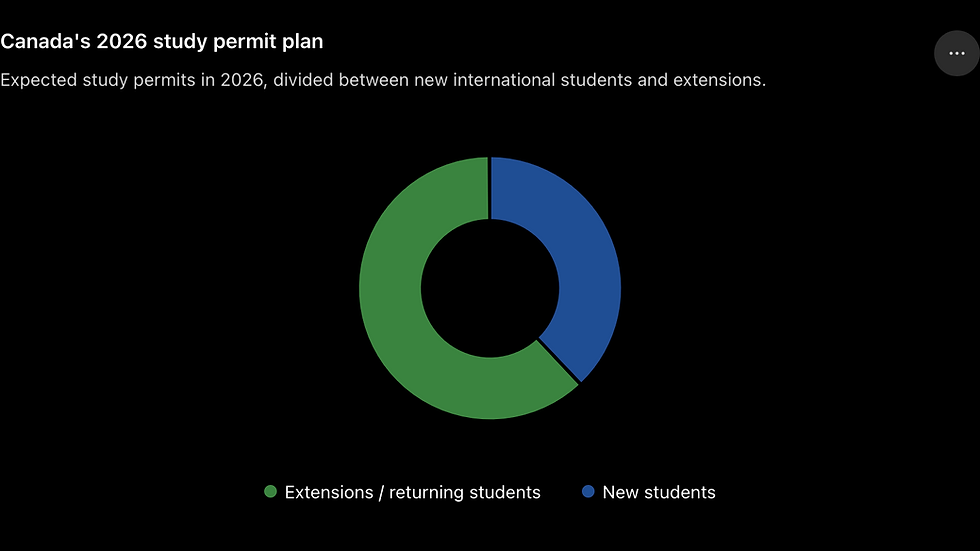
For 2026, IRCC expects to issue up to 408,000 study permits.
However, this number needs to be understood correctly.
It consists of:
155,000 study permits for newly arriving international students
253,000 extensions for current and returning students
As of 31 January 2026, only 7,040 study permits had been issued for the year.
The distinction between new students and extensions is important. The headline figure of 408,000 does not mean Canada plans to bring 408,000 new international students into the country.
The actual 2026 target for new student arrivals is 155,000.
The international student population has also declined
Canada's international student population has fallen considerably.
At the end of 2024, approximately 928,430 people held study permits in Canada.
By 31 December 2025, this had fallen to approximately 691,215 study permit holders, representing a decline of about 26%.

As of 31 January 2026, the number had increased slightly to approximately 695,465 study permit holders.
This reflects the combined effect of fewer new arrivals, tighter study permit controls and changes affecting existing temporary residents.
Study permit refusals have reached 62%
Perhaps the most important figure for prospective students is the study permit refusal rate.
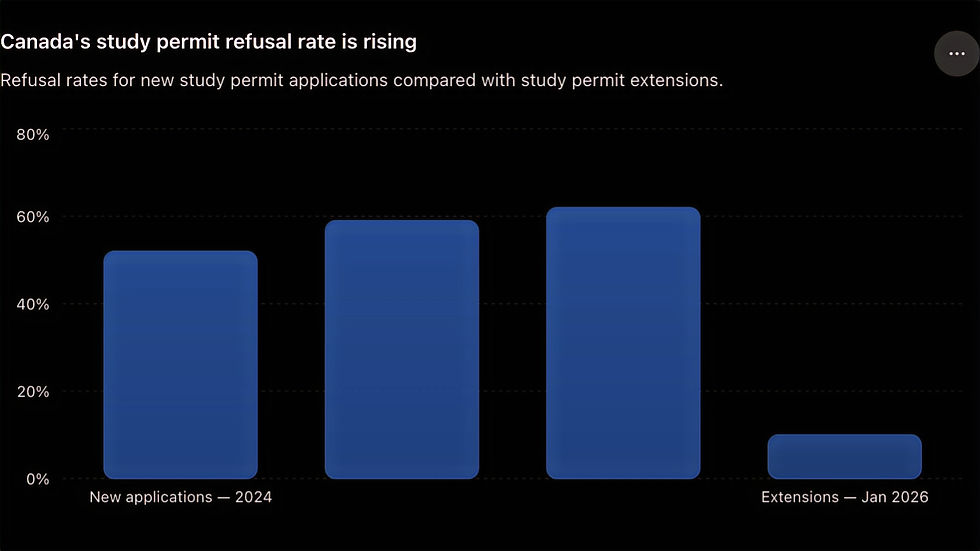
IRCC reports that the refusal rate for new study permit applications reached 59% during 2025, compared with 52% in 2024.
By 31 January 2026, the refusal rate for new study permit applications had risen further to 62%.
By comparison, the refusal rate for study permit extensions was only 10%.
This difference is significant. It suggests that Canada is taking a considerably more cautious approach toward new applicants while existing students who are already studying in Canada and meeting their requirements face a substantially different environment when extending their
For new applicants, simply obtaining admission to a Canadian institution is therefore no longer enough.
Applicants need to demonstrate that they genuinely intend to study, have the financial capacity to support themselves, meet the requirements of their program and have a credible overall application.
Canada is placing greater emphasis on genuine students
The Canadian government says its reforms are intended to attract students who genuinely contribute to Canada's educational and economic objectives.
IRCC has also indicated that the reforms are resulting in a greater proportion of students coming to Canada to study at the university level, which is more closely aligned with the government's talent-attraction objectives.
This could have important implications for applicants considering different types of Canadian education.
Students should increasingly focus on whether their proposed program makes sense in light of their previous education, employment history, career plans and long-term objectives.
A course selected primarily because it appears to offer an easier route to Canada may face greater scrutiny than a program that demonstrates a logical academic and professional progression.
Financial requirements have also increased
Canada has also increased the amount of money international students must demonstrate for living expenses.
As of September 2025, a single student applying outside Quebec is required to demonstrate CAD $22,895 for living expenses, excluding tuition and transportation costs.
The financial requirement is updated annually to reflect changes in the cost of living.
This means prospective students must budget for significantly more than tuition fees alone.
A strong financial application should demonstrate that the student has realistic access to sufficient funds for:
Tuition
Accommodation
Food and daily living expenses
Transportation
Travel to and from Canada
Other expected study-related expenses
Applicants should also be prepared to explain the source of their funds where appropriate.
Canada is strengthening verification of admission letters
Another major change concerns the verification of Letters of Acceptance (LOAs).
Since December 2023, IRCC has been directly verifying LOAs with Canadian designated learning institutions before issuing study permits.
In 2025, IRCC verified more than 368,000 LOAs.
Approximately 4,900 were flagged as "no-match" cases, meaning the information did not initially match the institution's records.
Importantly, a "no-match" does not automatically mean that an applicant committed fraud.
IRCC says that approximately 35% of the no-match cases in 2025 were subsequently resolved after applicants were able to provide a verifiable LOA through the procedural fairness process.
The remaining cases were either withdrawn or refused.
The proportion of LOAs producing a no-match result also fell from 2.2% in 2024 to 1.3% in 2025, suggesting that verification is becoming more effective and may also be deterring fraudulent applications.
Students are now subject to stricter compliance requirements
Canada has also strengthened its monitoring of international students after arrival.
Under the International Student Compliance Regime, designated learning institutions report information to IRCC regarding whether international students are actively enrolled and studying.
In autumn 2025, 587 of 648 designated learning institutions, or 91%, responded to IRCC's request for information covering approximately 454,667 international students.
Of the students reported:
90% were identified as likely compliant
Approximately 38,394 students, or 8%, were initially flagged as potentially non-compliant
Approximately 1% had no data reported
IRCC stresses that being flagged as potentially non-compliant does not mean that a student has been confirmed to have violated their study permit conditions. Further verification and, where appropriate, procedural fairness are required before a final determination is made.
This reinforces an important message for current students: maintaining valid status and genuinely studying in Canada are increasingly important.
Students can work up to 24 hours per week off campus
Canada also introduced a limit of 24 hours per week for international students working off campus during academic sessions.
The government has emphasized that the purpose of these reforms is to ensure that international students come to Canada primarily to study rather than using the study permit as a route into the Canadian labour market.
Students should therefore not build their financial plans around working excessive hours while studying.
The ability to work should be viewed as supplementary rather than as the primary source of funding for an international education.
What does this mean for students?
For students from Kenya and other African countries, the latest figures highlight the importance of preparing stronger applications rather than simply submitting more applications.
The Canadian study permit environment is considerably more competitive than it was several years ago.
A successful application should tell a consistent story:
Education → chosen program → career objective → financial capacity → reasons for studying in Canada → credible plans after graduation.
Students should carefully consider:
Why this particular course?
Why this institution?
How does the course relate to previous education or employment?
How will the studies improve the applicant's career prospects?
Can the applicant genuinely afford the cost of studying in Canada?
Are the financial documents credible and properly supported?
Does the applicant understand the conditions attached to a Canadian study permit?
The higher refusal rate means weaknesses that may previously have been overlooked can potentially have a much greater impact on an application.
Canada is not closing the door to international students
Despite the significant reductions, the latest figures should not be interpreted as Canada abandoning international education.
International students remain economically important to Canada.
According to Canadian government figures, international students contributed approximately CAD $39 billion to Canada's GDP in 2024, equivalent to around 1.4% of GDP.
They also spent approximately CAD $47.5 billion in Canada, generated approximately CAD $9.4 billion in tax revenue, and supported more than 407,000 jobs in the Canadian economy.
The government's objective is therefore not necessarily to eliminate international student recruitment, but to move toward a smaller and more controlled system.
The message from IRCC is increasingly clear: Canada wants fewer students, but it wants students who are genuine, financially prepared and academically aligned with the country's needs.
What prospective students should do now
For anyone considering Canada for the 2026 or 2027 intake, the changing environment makes early preparation more important than ever.
Students should avoid choosing institutions or programs solely because they appear inexpensive or easy to access.
Instead, applicants should evaluate the entire study plan, including the institution, program, tuition fees, career prospects, financial requirements and immigration implications.
They should also ensure that all documents are genuine and consistent. Canada's increased use of LOA verification and other program-integrity measures means discrepancies can receive greater scrutiny.
The bottom line
Canada remains an attractive destination for international education, but the era of rapid expansion in international student numbers is over.
The latest IRCC figures show:
61% fewer international students arrived in Canada in 2025 compared with 2024.
62% new study permit refusal rate as of January 2026.
155,000 new international student arrivals targeted for 2026.
408,000 total study permits expected in 2026, including extensions.
26% decline in study permit holders between the end of 2024 and the end of 2025.
CAD $22,895 minimum living-expense funds required for a single student as of September 2025, excluding tuition and transportation.
For prospective students, the lesson is straightforward:
Students who approach the process with a genuine academic objective, credible finances, a carefully selected program and a well-prepared application are better positioned to navigate Canada's increasingly selective international student system.
Source: Immigration, Refugees and Citizenship Canada (IRCC), CIMM – International Students briefing, March 23, 2026.


Comments